3 Examples of AI Agents Used in News Organizations
What are AI agents, and how can they be used in newsrooms? | Twipe Insights
Published 21.4.2026 | Foto/Video: AI generated, Freepik
Remember the early “AI chatbot craze”? It was defined by a simple interaction: a human asks, and an AI answers. That already feels like a distant phase. As the technology has matured, so has the scope of its applications. Today, the conversation is shifting toward AI agents, systems that can act more autonomously and even prompt themselves. But what exactly are AI agents, and how can they be used in newsrooms? This article explores both questions.
What is an AI agent? Understanding the difference
To understand AI agents, it helps to first define what they are not. We can think of the evolution in three steps.
1. Traditional automation
Traditional automation is rule-based. It executes predefined workflows: if X happens, do Y. It works fine for scheduled posts or routing alerts, but someone has to think through every possible scenario in advance.
2. AI automations
LLMs and AI automations introduced flexibility. A product manager might use an LLM to automatically generate metadata, suggest headlines, or draft social media captions. But they’re still isolated—they live in a chat window with limited access to your newsroom systems, understanding of what’s already published, or awareness of what other tools are doing.
3. AI agents
AI agents operate differently. An agent is an autonomous system that:
Integrate with external tools and workflows: Rather than working in isolation, agents can query databases, pull from content management systems, interact with APIs, and coordinate with other agents to accomplish broader goal
Perceive and interpret complex environments: They have access to multiple data sources and understand how different systems interact
Make decisions autonomously based on goals, not just individual prompts: They can break down a complex task into subtasks and execute a sequence of actions
Operate in loops with feedback: They can evaluate their progress, adapt their approach, and refine their outputs based on results
3 examples AI agents at work in news organizations
What better way to better understand AI agents than showcase how they are being used in practice in newsrooms today?
From Jira Tickets to Shipped Features: The Philadelphia Inquirer
Here’s one for product manager and developers in news organizations.
The Philadelphia Inquirer’s engineering team built an AI that helped with the speed of their product development. The usual process would go as follows: A product manager writes a Jira ticket specifying a feature and linking to documentation and design files. A developer reads it, creates a branch, and starts coding.
Instead, they built an agent to handle these tasks. When a ticket is flagged “readyforAI,” the agent fetches the spec, pulls documentation from Confluence, grabs designs from Figma, creates a git branch, and writes the code using Claude Code. If anything’s missing or unclear, it comments on the Jira ticket and waits.
What makes this system (and agents in general) so powerful is that rather than blindly processing a single document, it pulls context from four different systems—requirements, docs, designs, codebase—then runs linting, starts a dev server, and surfaces issues.
Interested in seeing how this agent is developed? Check out their GitHub repo.
The Social Media Assembly Line: DMG Media
DMG Media, the publishes the Daily Mail, created their own AI agent system called Mail iQ to help with a variety of tasks
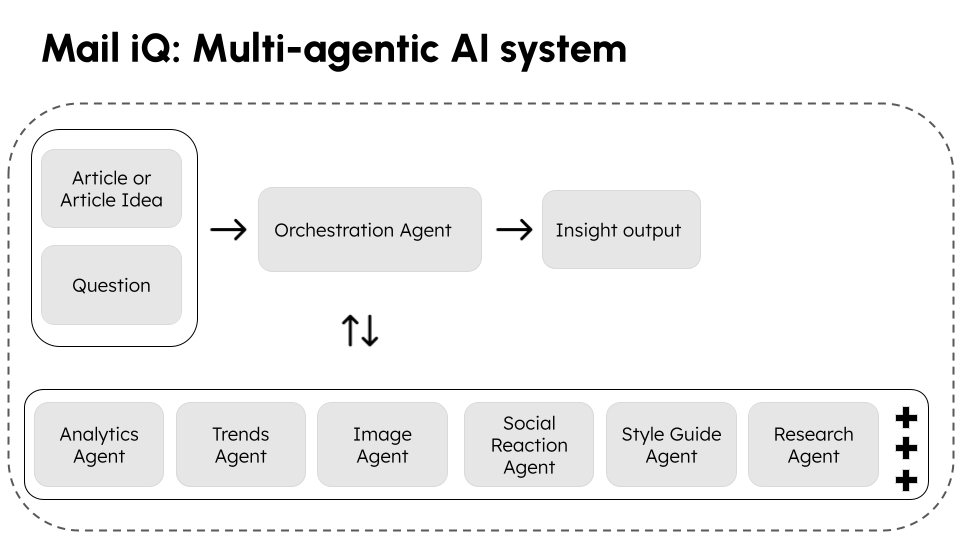
Mail iQ is built on a multi-agentic architecture, a master orchestrator agent that manages several specialized sub-agents, each with a specific role:
Editorial style guide agent: Analyzes article drafts against DMG’s style guidelines and suggests corrections (grammar, tone, formatting, specific brand rules)
Metadata agent: Generates SEO-optimized headlines, tags, URLs, and other metadata fields that journalists must fill out
Social asset generation agent: Creates multiple versions of social media content based on the article, optimized for different platforms (X, Instagram, Reddit, Facebook)
Performance insights agent: Analyzes historical data and real-time trends to suggest relevant story angles and content additions
Newsroom intelligence agent: Aggregates insights and provides journalists with contextual suggestions about timely content opportunities
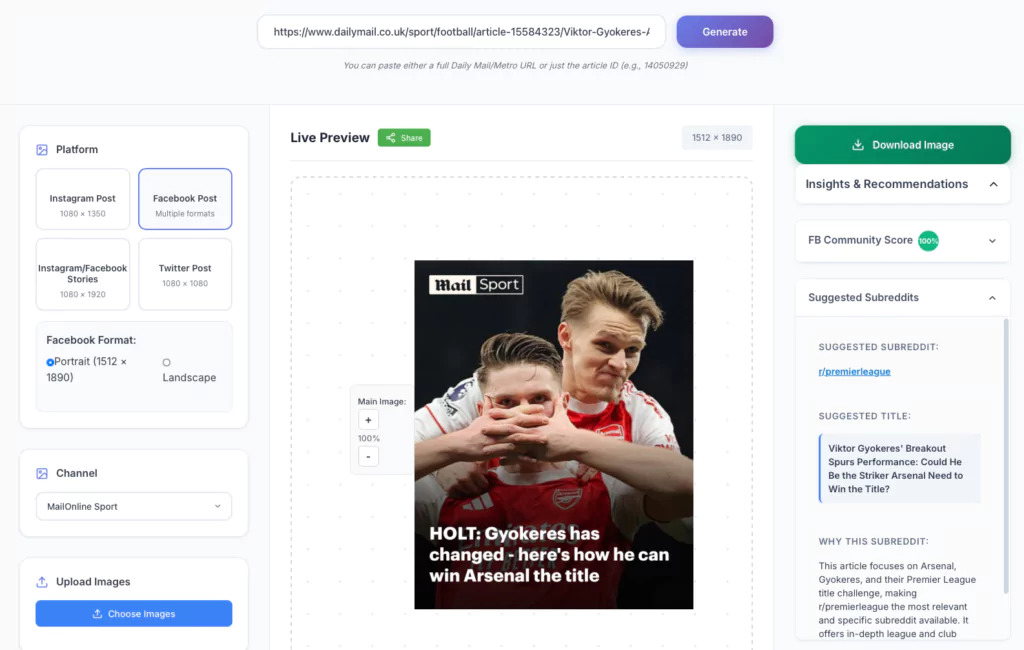
The impact is measurable. DMG’s social teams now produce over 300 assets daily. What took five minutes per post now takes less than one. More importantly: consistency. The agent knows which subreddits matter, sizes images correctly for each platform, maintains brand voice across continents and time zones.
Video from Articles, Automatically: Schibsted
Video drives engagement, however, not all newsrooms also can’t afford dedicated video teams. Schibsted—which owns VG, Aftonbladet, TV4—solved this with Videofy, an agent that turns articles into short-form video.
It is an AI agent system that orchestrates the entire video production pipeline. Here’s how it works:
Content ingestion: The agent monitors published articles in the CMS and selects suitable stories for video adaptation
Script generation: It extracts key information from the article and automatically generates a concise, engaging video script (through OpenAI)
Asset selection: The agent searches for and matches relevant images and video clips from internal libraries
Voiceover production: It generates audio narration with natural-sounding voice synthesis (using ElevenLabs)
Assembly and review: The agent compiles the final video and routes it to editors for approval before publication
What makes Videofy an agent system and not just automation: it makes decisions (which stories deserve video?), coordinates across multiple tools, and operates within a feedback loop. It’s autonomous but grounded in human judgment. It doesn’t run once and disappear. It adapts to different brands and voices, and lets editors intervene at every stage.
As Schibsted’s Director of Data & AI, Juan Carlos Lopez Calvet, puts it at Twipe’s 2025 Digital Growth Summit, Videofy lets them “streamline production of short news videos without proportional increases in staff.” But it also revealed enough promise that they open-sourced it—recognizing that smaller newsrooms face the same constraint but lack the resources to build solutions themselves (see GitHub repo here).
If you’re interested in how AI is being used in the news industry, join us on October 15th in Leuven (Belgium) for our 9th annual Digital Growth Summit. Hear case studies on how tech is shaping the future of news and connect with senior product leaders and news professionals for a day of learning.

Sarah Cool-Fergus is Marketing Lead at Twipe.
First published in Twipe's blog.